> ## Documentation Index
> Fetch the complete documentation index at: https://docs.getbindu.com/llms.txt
> Use this file to discover all available pages before exploring further.
# The Bindu Inbox
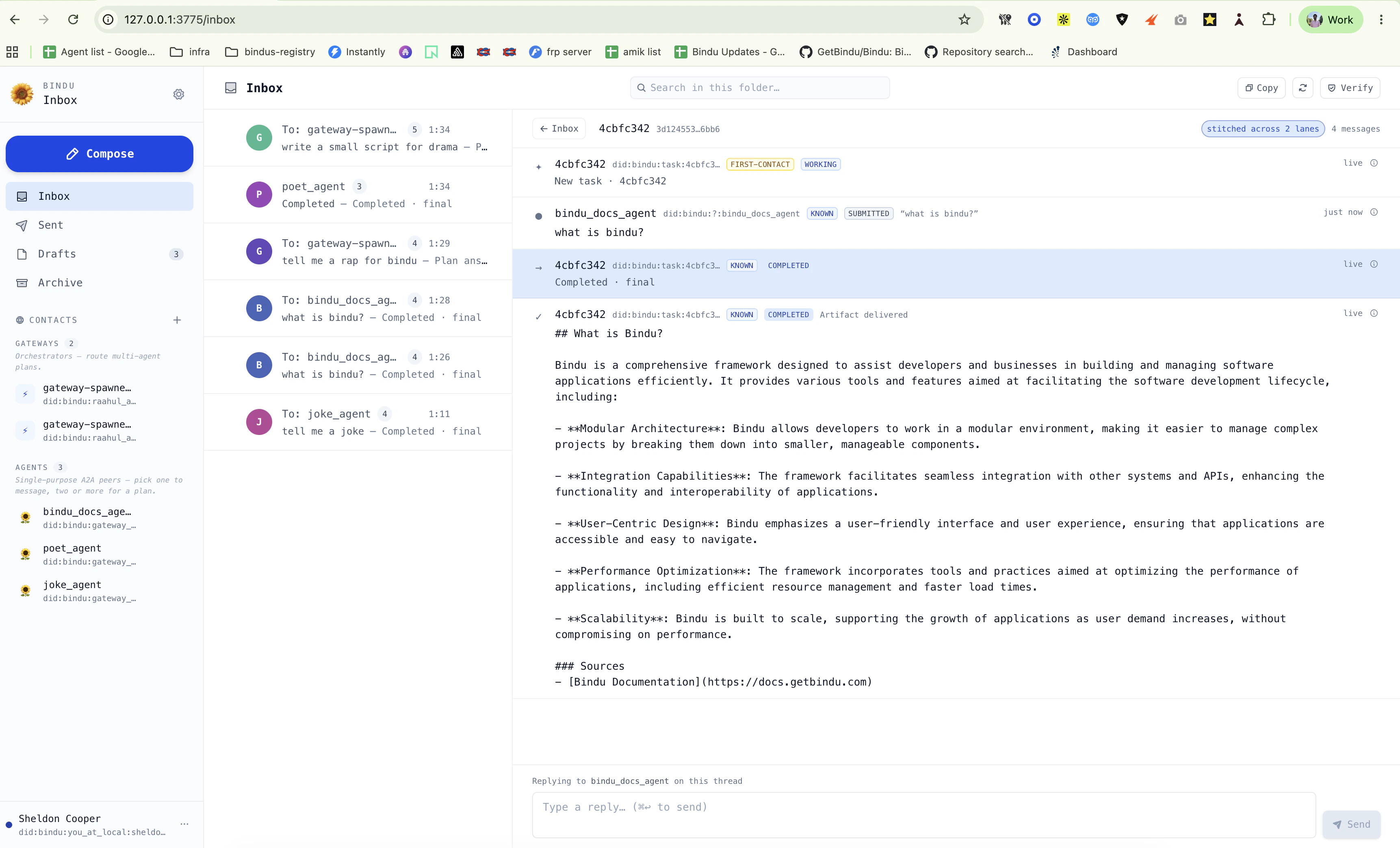
> A Gmail-shaped operator console for the A2A network — every signed JSON-RPC call between two DIDs, threaded and verifiable from the right rail.
**Budget about 20 minutes** to go from `git clone` to a signed message landing in the right rail. **No prior bindu knowledge required** — every step in the next chapter explains what it does and what you should see.
You've built an agent. Maybe two. They talk to each other over A2A. But the *traffic itself* — who called whom, with what body, signed by which DID, with which Hydra token — is invisible. It's HTTP. It's gone the moment it lands.
The inbox is the thing that makes that traffic visible. Every JSON-RPC message between two DIDs lands here as a row. Threads group by `context_id`. Signatures are verified inline so you can see whether a peer is actually who it claims to be. It's an **operator console** — for you, your auditor, and your future self trying to figure out what went wrong at 2am.
***
## The roadmap
The five processes that make the inbox tick, and why each one is there.
Five steps. One persona. Two demo peers. One signed message.
Prove from your terminal that calls really are signed and authed.
Layout, sending, reading a thread, replying.
Common boot failures and the env knobs that fix them.
***
## Why this exists
Most agent frameworks treat the wire as someone else's problem. You write a handler, you `POST` to it, you hope it returns. If something goes wrong — wrong signer, expired token, a peer that lied about its DID — you get a stack trace and you start grepping logs across three machines.
The inbox flips that. It treats **every A2A message as a first-class object** with:
* A **state pill** — `submitted` · `working` · `input-required` · `payment-required` · `auth-required` · `completed` · `failed`.
* A **trust pill** — `first-contact` (new peer) · `known` · `self` (your own agents / planner).
* A **DID** of the counterparty — click for the full agent card.
* The **canonical body** that was signed, the **signature**, and the **timestamp nonce** — all verifiable inline.
You don't have to trust the UI. The Verify tab in the right rail re-runs the signature check against the peer's published `publicKeyBase58` — same code path a hostile peer would face on the wire.
***
## What ends up running
By the time you finish the [quickstart](/bindu/inbox/quickstart), five things will be alive on your machine:
| Port | Process | What it does |
| ----------------------- | ----------------------------------------------- | ------------------------------------------------------------------------------------- |
| `3775` | Vite dev server | The React UI you open in your browser. |
| `3787` | Hono API (`server/index.ts`) | SQLite event store, webhook intake, outbound A2A composer. |
| `` (e.g. `5xxxx`) | Your personal agent (Python, spawned on demand) | Your DID + Hydra OAuth client. Listens for inbound A2A and signs everything you send. |
| `5773` + `5776` | Demo peers (joke + poet) | Two example agents to talk to. Optional — bring your own if you have them. |
| `3774` | Gateway (optional) | The planner. Only spawns when you message ≥2 agents at once. |
`3775` is hard-pinned (Vite refuses to drift) and `3787` is hard-coded; both have to be free before you start. If something else is on those ports the inbox won't boot — see [Troubleshooting](/bindu/inbox/troubleshooting#port-already-in-use).
***
## What "auth on" means here
There are three independent auth layers in play. The inbox uses all three:
| Layer | Who enforces it | Default |
| ------------------------------------------------------------------- | --------------------------------------------------- | --------------------- |
| **Peer A2A auth** — outbound calls must carry a JWT + DID signature | The peer's bindufy middleware (`-32009` if missing) | **On** |
| **Operator gate** — `/api/*` on the inbox requires a bearer token | `inbox/server/index.ts` | Off (single-user dev) |
| **Webhook gate** — agents POSTing back must carry a bearer token | `inbox/server/index.ts` | Off |
The first is non-negotiable once your personal agent is alive. The other two are belt-and-suspenders for multi-user or exposed deployments — leave them off until you actually share the URL. The full mechanics live in [Verify the auth](/bindu/inbox/verify-auth#what-auth-on-means).
***
## What the inbox is not
Threads are grouped by `context_id`, not by contact. The same peer can show up in dozens of unrelated threads and the inbox treats each one independently.
Your personal agent runs as a separate Python process the inbox spawns on demand. Demo peers and any peer you add run wherever they run. The inbox is the *observer*.
Single operator, single machine. `BINDU_COMMS_TOKEN` is a gate for sharing the URL with a teammate; full SSO is on the roadmap.
***
## What you'll have by the end
Your operator DID (`did:bindu:::`), an Ed25519 keypair on disk, and a Hydra OAuth client registered to that DID.
`joke_agent` and `poet_agent` running locally with `AUTH__ENABLED=true` — same auth shape as a production bindufy agent.
A `Sent` row, an `Inbox` reply, both signed, both verified, both threaded under the same `context_id`.
Let's go. Next up: [Quickstart](/bindu/inbox/quickstart).
 The inbox doesn't generate traffic —{" "}
it makes the traffic legible.
The inbox doesn't generate traffic —{" "}
it makes the traffic legible.